Stage 1: Design and Planning (cont.)
Defining survey hypotheses
A hypothesis is a statement about the expected relationship between two or more variables that can be tested. For example, a single hypothesis might state that X is associated with variable Y, or that X causes Y. Like study objectives a hypothesis should flow logically once the research problem is clearly defined.
Study hypotheses:
- Help guide research;
- Are most appropriate for field intervention or evaluation studies;
- Are not always required for diagnostic or exploratory studies;
- Indicate key independent and dependent variables
- Guide the selection of the type of data to collect and analysis to conduct.
(Fisher 1991)
 Exercise to identify and define a research problem
Pakistan lags behind other countries in the region in levels of contraceptive use (CPR), unmet need for family planning (the percent of currently married women who are fecund and do not want to be pregnant yet are not using contraception), and total fertility rate.
Between 1990 and 2000 CPR more than doubled, (NIPS 1992, NIPS 2008), but in the decade since the increase has slowedand unmet need has increased (NIPS 2008). The abortion rate is also relatively high (29 per1000 women) (Sathar et al. 2007).
Percent of currently married women using contraception by area
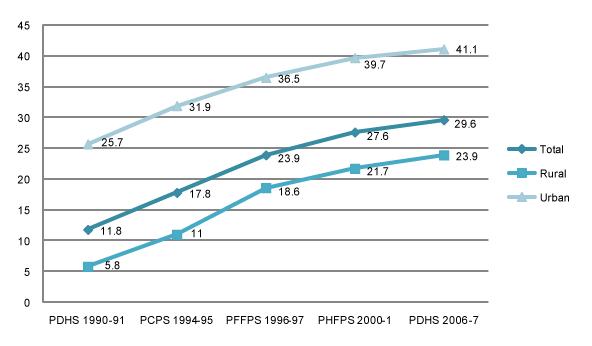
1a. From the information provided does a potential research problem exist?
1.b Describe in simple terms the discrepancy, in other words, what is happening and what should be happening.
Additional information: Access to reproductive health facilities is poor, and the quality often inadequate (Sathar et al. 2011). Furthermore the fear of side effects is an important barrier to contraceptive uptake.
2a. With this information in mind, list three possible reasons for the discrepancy.
2b. Write a broad research objective.
3a. Write four specific questions that would address the broad aim of the research, and help you to formulate more specific research objectives.
How did you get on? You may want to print out your ideas.
Here are some possible answers:
1b. Discrepancy: Contraceptive use is lower than expected, and the rate of increase in the last decade is slower than expected.
2a. Three possible reasons for the discrepancy:
- Lack of provision and poor access to services.
- Poor quality of services.
- Fear of side effects.
2b. Broad research objective: To explore reasons for the slower than expected increase in contraceptive use in the last decade.
3a. Specific questions:
- What percent of women currently use family planning?
- What are the reasons for non-use?
- Did they use in the past?
- What are the reasons for discontinuing?
Once a set of questions has been specified more precise objectives can be expressed.
Specific research objectives:
- to measure the method specific contraceptive prevalence rate among currently married women of reproductive age;
- to describe the reasons for non use of family planning;
- to describe the reasons for discontinuation of family planning;