Diagnostics (cont.)
Age structure of the population
A very common measurement error in data collected in less-numerate developing country populations relates to individuals’ reports of their ages. Commonly, if age is unknown, respondents will round ages to the nearest multiple of five. If this happens in significant numbers, a clear pattern of heaping on ages will be evident.
The figure below is derived from the data from the 2001 Census of Nepal.
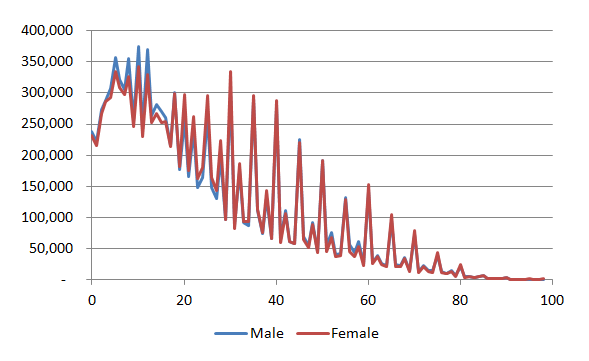
The most obvious feature of these data is the extreme heaping on ages ending in 0 and 5, for both men and women. There is also a lesser extent of heaping on ages ending in 2 and 8.
A further kind of age heaping – not visible in the data here – arises if the age of subjects is derived from reported dates of birth, heaping may be identified on months of births (January is often favoured), and on years of birth ending in 0 or 5. Depending on the date on which the data are collected, this may manifest itself in heaping on ages other than 0 or 5. If a survey was conducted in 2011, for example, and ages were derived from dates of birth, one might anticipate heaping on ages ending in 1 or 6. Again, a clear understanding of how the question was asked in the instrument is required to identify such heaping.