Ex-ante assessments of the accuracy of forecasts (cont.)
The limitations of the statistical approach to estimating the accuracy of forecasts are evident in the following figure. The confidence intervals indicated by the black dotted lines are very wide. Thus, the prediction states with only 80 per cent confidence that over the 25-year period the population of England and Wales will have grown from 54 million in 2007 to between 55 million and 74 million in 2033, with a central estimate of 64 million.
The analysis shown in the figure is an exploratory one and the forecasts could probably be made more precise by integrating the statistical method of forecasting with a cohort-component projection method that takes into account the ageing of the population. As discussed shortly, it can also be refined using Bayesian statistical methods. Nevertheless, it illustrates the problem with the purely statistical approach. Even in the medium-term, the confidence intervals are worryingly wide. Moreover, in the longer-term, the likely errors would rapidly become far greater even than this.
The lesson would seem to be that forecasting the population in anything but the short-term is effectively impossible. Even if there is an element of truth in this, giving up population forecasting is not an option and the conclusion that the population could be any size is not a helpful one.
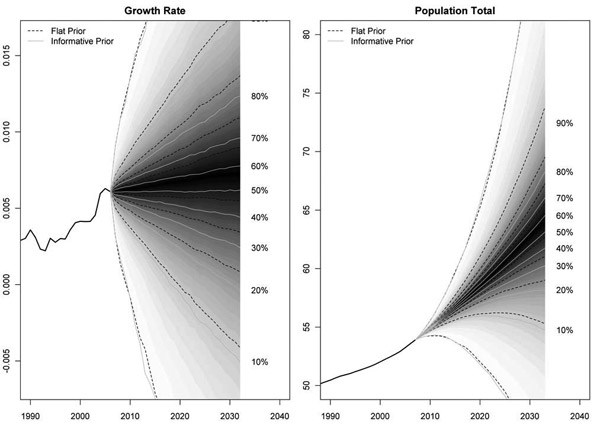
Predicted probability distribution of the growth rate and population of England and Wales, 2007-2033, forecast using Bayesian time series methods.
Source: Abel et al. (2010) under the Open Government Licence v.1.0.