Projecting service use
The approach used most often to predict the labour force, school enrolments, households and other service-related population statistics is based on the idea of a 'participation rate'. This is the proportion of the population that have the characteristic of interest or that use the service of interest. The steps involved in producing the forecast are:
- forecast the future population by age and sex
- forecast age-sex-specific participation rates
- combine the two forecasts to estimate needs:
Participants = Participation Rate × Population
Some examples of this approach include:
- Forecasts of the labour force participation rate by age and sex in a local employment market can be used to predict the size of the future labour force in that area.
- Forecasts of the future number of households, and therefore of housing needs, are often made by forecasting household headship ratios by age, sex, and perhaps marital status. Multiplying these ratios by forecasts of the population yields forecasts of the number of household heads and, thereby (because each household has a head), of households.
- Forecasts of households within 15 minutes travelling time of a planned superstore and of the proportion of households who will shop there can be used to forecast sales.
An alternative approach to that based on participation rates is to use multi-state methods to project each group of interest separately by explicitly modelling flows between the states (for example, from the economically active population to the inactive population and vice versa). As for regional projections, this approach is theoretically superior to the use of participation rates but involves producing forecasts of the future transition rates between all the different states in the model.
Exercise
The following table and figure present statistics on secondary school enrolments in Ghana for the period 1999-2009.
| School year |
Number enrolled |
Secondary school aged population |
Gross enrollment ratio (%) |
|---|---|---|---|
| 1999 | 1,024,100 | 2,548,700 | 40.2 |
| 2000 | 1,056,600 | 2,607,400 | 40.5 |
| 2001 | 1,029,200 | 2,665,600 | 38.6 |
| 2002 | 1,107,200 | 2,724,600 | 40.6 |
| 2003 | 1,170,700 | 2,783,500 | 42.1 |
| 2004 | 1,276,600 | 2,842,500 | 44.9 |
| 2005 | 1,370,200 | 2,902,700 | 47.2 |
| 2006 | 1,454,000 | 2,962,900 | 49.1 |
| 2007 | 1,617,800 | 3,014,600 | 53.7 |
| 2008 | 1,723,700 | 3,063,400 | 56.3 |
| 2009 | 1,836,300 | 3,109,400 | 59.1 |
| 2010 | 3,645,800 | ||
| 2011 | 3,694,800 | ||
| 2012 | 3,742,500 |
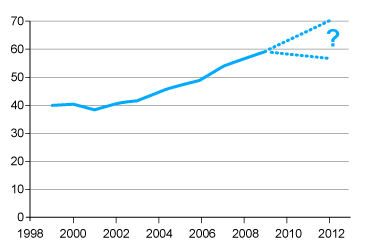
Source: UNESCO
 Forecast the enrolment ratio in the 2012 school year.
The correct answer is: 66.75
Please attempt the answer.
That seems to be a plausible forecast. The plot of the data reveals that the gross enrolment ratio in Ghana rose steadily between 2001 and 2009. It seems reasonable to assume that this rise will continue for at least a few more years. An exact estimate for 2012 can be calculated in various ways, including linear regression of the enrolment ratio on school year. One simple approach is to calculate the average increase in the ratio between 2001 and 2009. This is (59.1-38.6)/8 = 2.56. If we assume that the enrollment ratio will increase by the same amount for three further years, this gives a forecast for 2012 of 59.1 + 3 × 2.56 = 66.8.
That is a rather extreme forecast: please reconsider your answer.
Using a gross enrolment ratio of 66.8%, forecast the number of pupils enrolled in secondary school in Ghana in 2012. N.B. Do not separate the thousands with commas in your answer.
The correct answer is: 2499990
Please attempt the answer.
Yes that's correct. In fact, more up-to-date statistics are now available and show that only 2,215,500 pupils were enrolled in secondary school in Ghana in 2012 and that the enrolment ratio was still only 59.2 per cent. Unfortunately for forecasters, past trends are not always a reliable guide to future trends.
Sorry, that is not correct. Please try again.