The Bongaarts-Feeney tempo-adjusted TFR (TFR*) (cont.)
To understand the mechanics of the Bongaarts-Feeney adjustment, it is worth first considering parity 1 (Figure 3). In the figure all women from each birth cohort have their 1st birth at exact age x, all birth cohorts have the same number of women and all births occur at intervals of 0.2 years.
 Suppose that MAC1 gradually increases with 0.2 years during the year (t, t+1) (click on the button named Delayed childbearing to see this). In that scenario, the number of births in (t, t+1) declines by 20% (4 instead of 5 births occur between t and t+1), and the period TFR1 will be deflated by 20%.
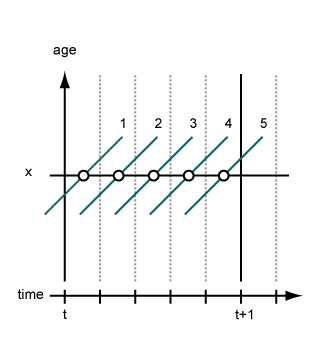
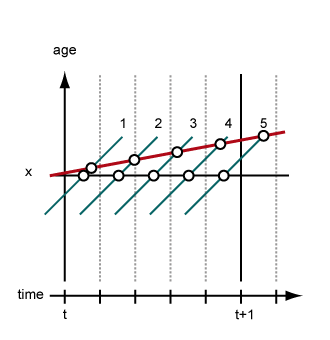
Figure 2: Lexis diagram illustrating tempo changes in fertility
Source: Adapted from Bongaarts & Feeney (1998)
Using data from the scenario with delayed childbearing, we can estimate the number of births (B*) in the absence of tempo changes as:
Where r1 is the annual rate of change in the period MAC1. This adjustment can be extended for rates and all birth orders combined as:
One of the important assumptions underlying this method is that all birth cohorts are assumed to respond in the same way to period influences (i.e., tempo distortions are independent of the birth cohort).