Generalized stable population models
Age structure from past rates (cont.)
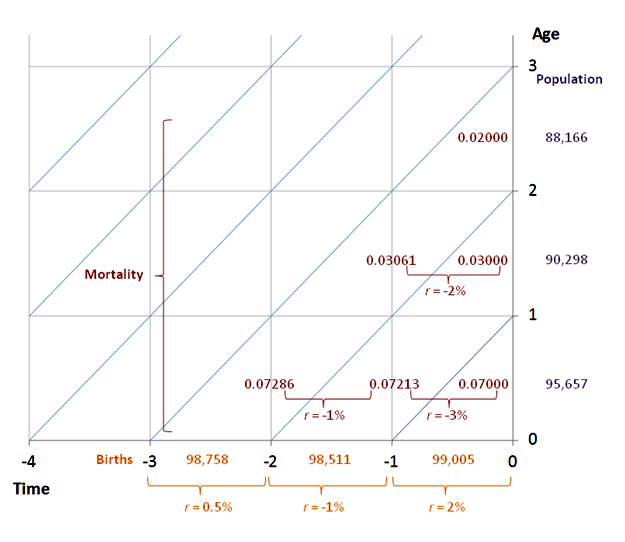
In a non-stable population with constant mortality but fluctuating numbers of births, the proportion of the births that die by any age never changes. As a result, if births grew by rB(-x) between x and x+1 years ago, then the population aged x will grow by the same amount this year. Therefore, the population growth rate at any age x equals the growth rate in the number of births exactly x years earlier.
For example, with constant mortality, the growth rate in the population of infants at any moment of time is just the growth rate in the number of births during the previous year, r0(0) = rB(0). Similarly, the growth rate in the number of one-year old children is identical to the growth rate of the births in the year before that, r1(0) = rB(-1), and so on. Thus, in our hypothetical population, the growth rate of the infant population would be 2 per cent, that of the one-year old children -1 per cent, and so on.
In a population in which the death rate, ma, was changing in just one age group, a, this would have the same effect on the population above age a that changes in rate at which births increase have on any age. The current growth rates at all older ages, x, would equal the change in mortality x-a years earlier:
rx(0) = ra(a - x) = - δma (a - x) if -x ≥ a
For example, if mortality was fluctuating at age 5, then the growth rate of the population aged 15 would depend on the change in mortality at age 5 that occurred 10 years earlier.