Sources of information
The Key Informant Method
Unfortunately surveys can be both costly and time consuming, although the extent of this is reduced if a disability module is included in a pre-existing survey. This is particularly a problem in low income settings, where the need for targeted interventions and data for service planning may be high.
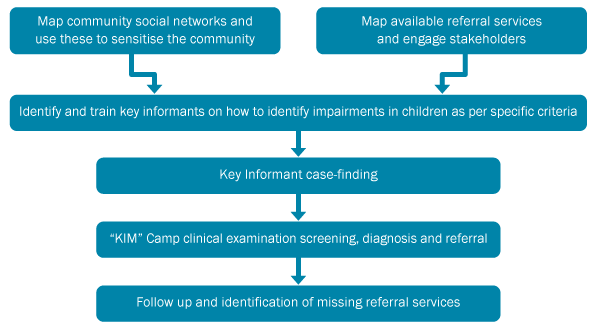
One method which has been developed to overcome these issues is the Key Informant Method (KIM). Designed to identify children with impairments in low income settings, KIM is reliant on unpaid community volunteers and therefore is far more cost-effective than door-to-door surveys. The community volunteers are usually individuals with influence in the community and access to community members, and are known as Key Informants. They are given training in the identification of impairments and case finding, and then return to their village to spread information and to draw up a list of identified children with impairments. Data from Key Informants can then be collated and children may then be referred to appropriate services, and the data collected used for regional and national estimation of numbers with impairments and used to plan future services.
The Key Informant Method
Copyright Prof. GVS Murthy & Islay Mactaggart 2014