Preferences for timing of childbearing
Not only the number of children but also the timing of childbearing has important consequences in one’s life and people often have preferences. Pregnancy at very young (<18 years) and older (>34 years) maternal ages, high parities and short pregnancy intervals are associated with adverse effects on maternal health, size and weight of a baby, and child survival (Cleland et al. 2012). Therefore, assessment of birth intervals and timing of childbearing is important.
Figure 12: Ideal age to become a mother, Kaplan-Meier estimate of actual median age at first motherhood, minimal age for motherhood, and maximal age for further childbearing in Europe, 2006-07
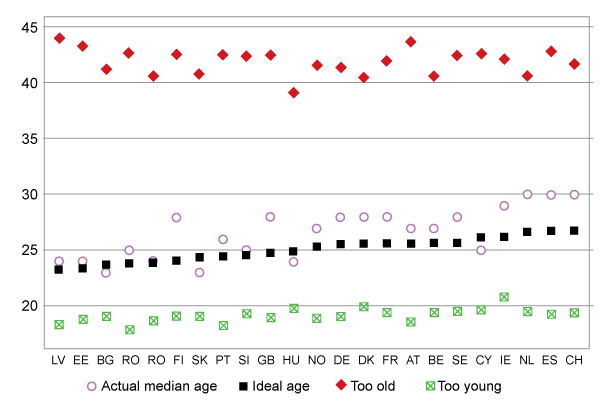
Source: Van Bavel and Nitsche (2013). (LV: Latvia, EE: Estonia, BG: Bulgaria, RO: Romania, PL: Poland, FI: Finland, SK: Slovakia, PT: Poland, SI: Slovenia, GB: Great Britain, HU: Hungary, NO: Norway, DE: Germany, DK: Denmark, FR: France, AT: Austria, BE: Belgium, SE: Sweden, CY: Cyprus, IE: Ireland, NL: Netherlands, ES: Spain, CH: Switzerland)
Ideal age at first birth in Figure 12 is derived from the question on normative idea about the timing of first birth; “In your opinion, what is the ideal age for a girl or woman to become a mother?” in European Social Survey from 23 European countries and respondents who were living with a partner at the time of the survey, where the female partner was between ages 15- and 45 years, who had at least one child.
The figure above shows that all the countries except Bulgaria, Slovakia, Hungary and Cyprus women on average had their first birth at age than the age they think ideal.
Figure 13: Preferred and actual birth intervals by region
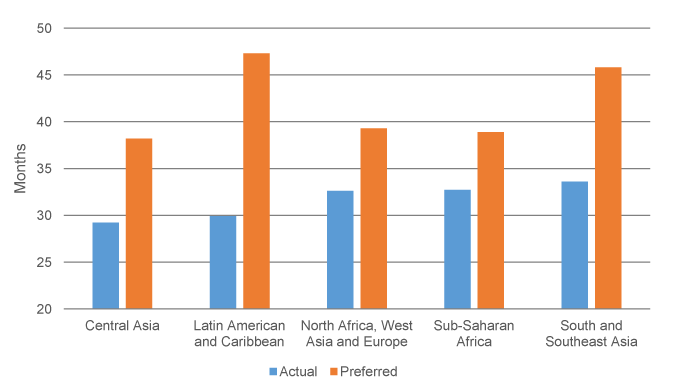
Source: Rutstein (2011)
The Latin America and Caribbean region and the South and Southeast Asia region have the longest preferred birth intervals, at 47.3 and 45.8 months, respectively. These two regions also have the greatest differences between actual and preferred birth intervals, at 17.4 and 12.2 months, respectively. However, large differences in preferred and actual birth intervals are remarkably similar in all regions.