Sex preferences for children (cont.)
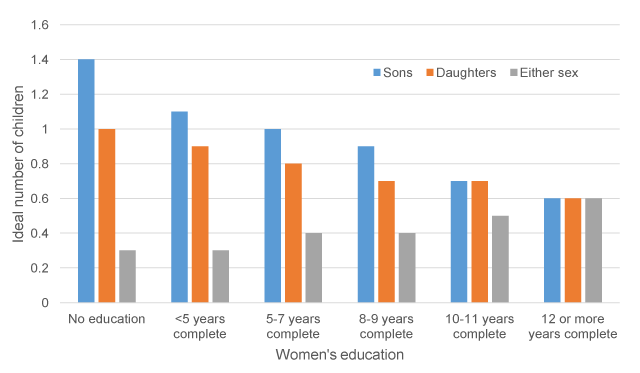
Figure 14: Mean ideal number of sons, daughters and children of either sex for women age 15-49, India 2005-06
Source: International Institute for Population Sciences (IIPS) and Macro International (2007)
 What can you tell from the figure? Select the missing words from the pull-down menus below.
1. Son preference has a clear gradient by women's education in India: women prefer sons more than the more educated. Women with no schooling wanted 1.4 sons and 1 daughter on average, whereas the most educated group wanted the same number of boys, girls and either sex.
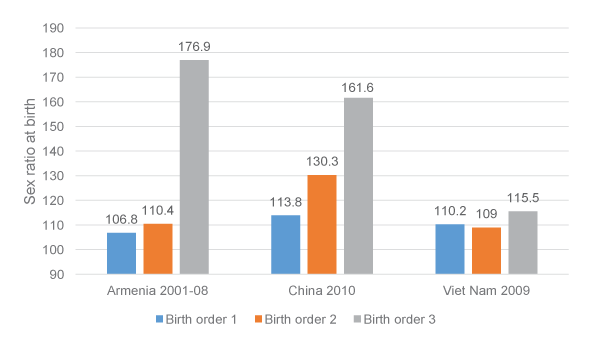
Figure 15: Sex ratio at birth by birth order, Armenia, China and Viet Nam, 2000-2009
Source: The data is derived from China: 2010 census; Armenia Statistical Office; Vietnam (UNFPA 2010). UNFPA (2012)
2. Gender preference for children can be revealed from reproductive behaviours, such as sex ratio at birth. Sex ratio at birth  usually falls within the rage of 104-107 male births for every 100 female births.
Three countries present different trends of sex ratio at birth by birth order. In Armenia, the sex ratio for the first child was within the expected range, but substantially increases to males to females at birth order 3. Abortion is permitted on broad legal grounds in the three countries. Among these, Armenia, as in other republics of the former Soviet Union, abortion has been an important method of birth control and easily available (Westoff 2005). Gender preference may not be important for first and second births, but seems very important, and easily influenced, for couples who may have had two girls initially. In China, the ratio is already high at birth order 1 and increase gradually with birth order. The different trend may reflect lower fertility preferences and the one child policy in China. In Viet Nam, the level in birth order is already but does not increase substantially with birth order.