Parity cohort PPRs
In addition to calculating parity progression ratios (PPRs) for age cohorts of women, it is also possible to calculate PPRs for parity cohorts. A parity cohort comprises the set of women in the population of interest that had a birth of a particular order in the same period of time. For example, women who had their 2nd birth in 2000–04 constitute a five-year parity cohort. The birth that defines the parity cohort, in this case the 2nd birth, is referred to as the index birth.
Assuming that data are available on the later childbearing history of these women, they can be used to calculate the PPR, that is the proportion of the 2000–04 2nd parity cohort that progresses to a 3rd birth and compare this PPR with those for earlier and later parity cohorts. In order to distinguish them algebraically, this session uses the notation an to refer to a PPR for an age cohort and a'n to refer to a PPR for a parity cohort.
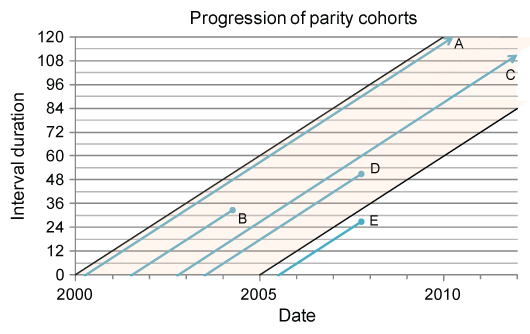
The figure illustrates this situation. Each blue line represents the time that a particular woman spent in their 2nd birth interval. It is assumed that the data were collected at the end of 2011 and that nothing is known about the women’s fertility after that. Women A, B, C and D all gave birth to their 2nd child at some point between the beginning of 2000 and the end of 2004 and entered the 2000–04 2nd parity cohort at duration 0. Because Woman E gave birth in the middle of 2005, she is not a member of this parity cohort.
Woman B and Woman D both closed their 2nd birth interval by having a 3rd birth. They did so at durations 33 months and 51 months respectively. In contrast, Woman A did not have another baby within 10 years of having her 2nd one. Similarly, Woman C had not given birth again by the end of 2012. Thus, both these women still had open birth intervals when they aged out of the range of durations and dates shown in the figure. Of course, they may yet close these intervals by having a third child at some point before their menopause.