Parity cohort PPRs (cont.)
Censoring and truncation bias
Birth history data suffer from two related but distinct limitations that need to be allowed for in the construction of parity progression ratios from them: censoring and truncation.
- Censoring occurs when one collects incomplete information on the events of interest because some of them occur after one collects the data. In this context, the events of interest are the women’s i+1th births and censoring occurs because women who are still of childbearing age at the time that the birth histories are collected will continue to bear children in the future. Each woman has an open birth interval. For women of childbearing age, all that is known about this interval is its length at the time of the survey, not whether or when the woman will close it with a further birth.
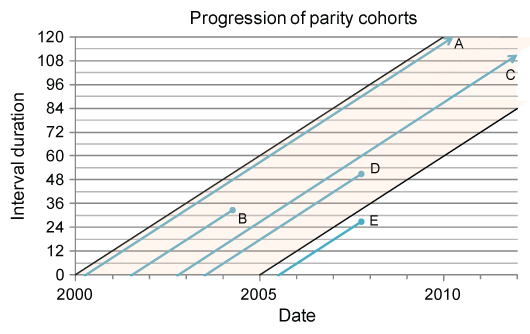
Consider the calculation of a'2(120) from the data in the figure that we have examined already. The information on Woman C is censored. Only information up to the end of 2011 is available on this woman. At that time her interval duration was 111 months. It is possible that she had a 3rd birth during the first 9 months of 2012, thereby closing her 2nd birth interval in less than 10 years. However, 2012 was still in the future when the data were collected, and so whether she did is unknown.