Parity cohort PPRs (cont.)
Censoring and truncation bias (cont.)
- Truncation is an issue because most inquiries only collect birth histories from women in a limited age range. For example, Demographic and Health Surveys.usually interview women aged 15–49. Thus, as one considers increasingly earlier dates preceding an inquiry, the information that the histories provide on fertility is restricted to a younger and younger group of women. For example, if data are collected on women aged less than 50, then they were all aged less than 40 a decade earlier.
Truncation is a problem because women who have achieved any parity before age 50 differ from all women who will do so eventually because, by definition, they have done so relatively rapidly. In other contexts, truncation of the data might not result in bias. However, PPRs calculated from truncated data are always and inevitably biased because, at every parity and date, the women providing the information have been selected for higher fertility than the population as a whole.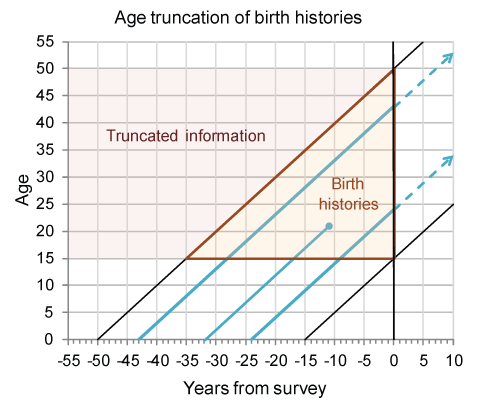
One important distinction between censoring and truncation is that, with appropriate life table methods of analysis, one can avoid bias due to censoring because the birth histories provide partial information on all interval durations. Truncation is a more intractable problem, however, because the inquiry collected no information on the fertility of older women for earlier dates.
The only way to address the truncation issue is to artificially truncate the more recent fertility data to make them comparable with the more distant data. For example, in the analysis of a Demographic and Health Survey, one might calculate a partial total fertility rate from the age-specific fertility rates for women aged 15–34 and use this to examine the trend in fertility over the 15-year period preceding the survey. The limitation of this strategy is obvious: the final measure provides no information about trends in fertility in the truncated part of women’s life course.